
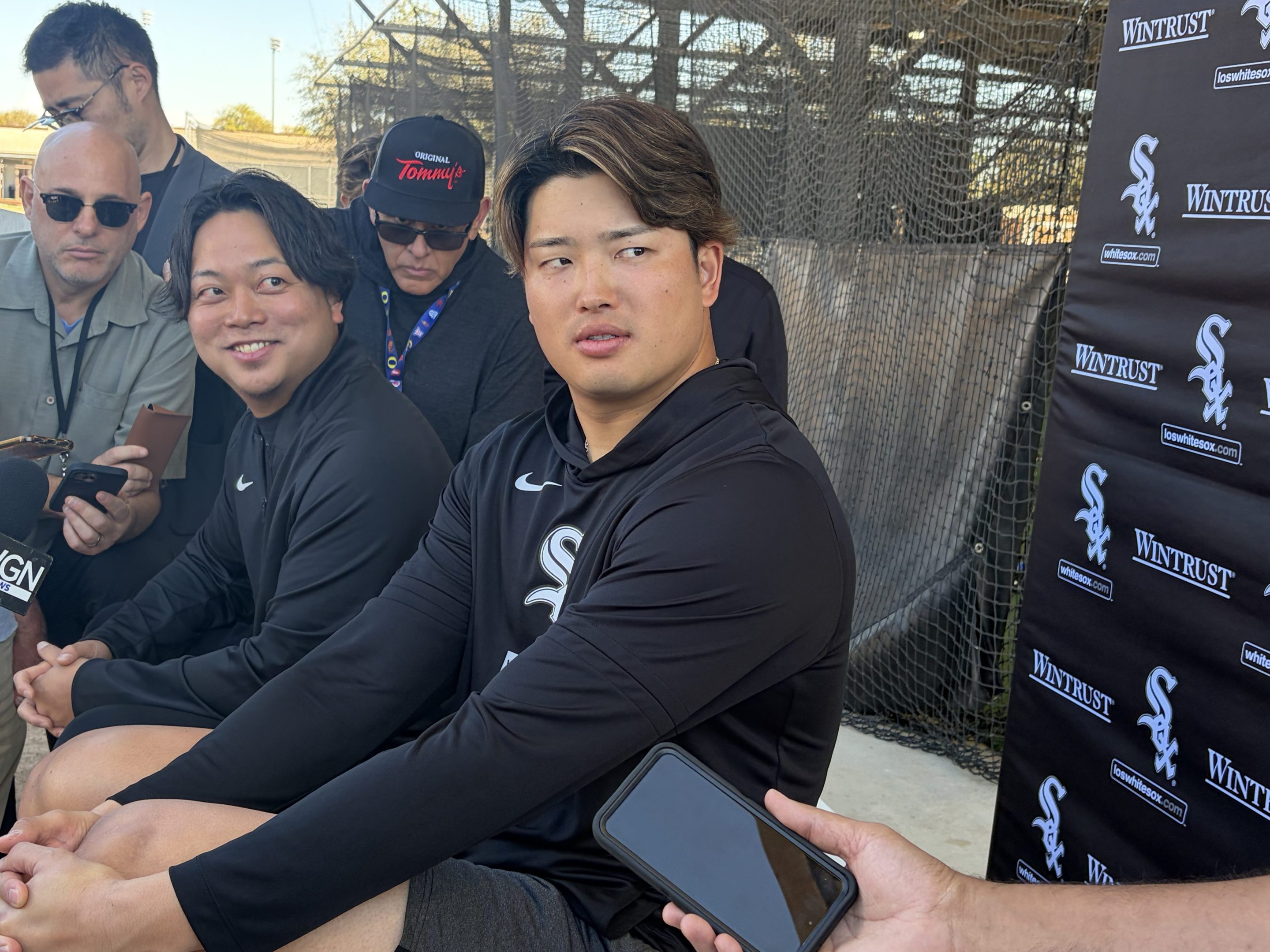
A few minutes into our interview, Kenzo Yagi is being pulled away by White Sox director of applied sports science Todd Kubacki. Munetaka Murakami is going to "do some things," and to do it right, his interpreter is needed.
Everyone is apologetic for the interruption, but it's a good example of the dynamic in question. Murakami's transition to the majors is going beautifully. He's leading the league in home runs, he's played in every White Sox game, and he's regularly praised for his diligent, detail-obsessed routine to both his swing and his body.
So, do you ever notice that when experts in hitting mechanics, or kinesiology really go in-depth on their field of expertise, they almost sound like they're speaking in a different language? In the case of Murakami, and his interpreter tasked accurately relaying the very technical information being presented, they actually are.
"The specific muscle terms and movements are very hard; it becomes more like textbook terms with the muscles and how the mechanics work," Yagi said. "Just inside the pelvis, there are different kinds of muscles that the trainers talk about when you're trying to find out what kind of movements go into the swing and such, and then it becomes more detailed and specific. And that's where I get to, like, 'I don't know this term.'"
Yagi had worked abroad aplenty in his prior life in the corporate world, has a degree in English communication, and has been a lifelong baseball fan dating back to when he spent a large chunk of his childhood growing up in Arizona. But it turns out that in 2026, the gap between "being a fan who follows the sport and watches games regularly" and "being able to accurately relay specific swing mechanic info and details of a training regimen to one of the preeminent sluggers in the sport" is quite large.
When Yagi got the surprising news in December that his interview had earned him the job as Murakami's interpreter, shadowing him through every day with the Chicago White Sox, he started cramming. He hasn't really stopped.
"I went to the bookstore to get as many baseball magazines as possible, started seeing who is doing good and not, who are the up-and-coming prospects," said Yagi, whose baseball fandom mostly consisted of watching NPB in his free time before getting hired to interpret Murakami. "I even bought MLB The Show; you know that's the easiest way to learn right now, because you can see where to throw, what not to throw."
For a White Sox-obsessed audience like this one, Yagi is sort of living out a collective dream with the peek behind the curtain of the inner-workings of an MLB team that his job offers. He's in the White Sox dugout for every game, draped in the cool Sox athleisure wear and following along with Murakami through every step of practice, even bringing his own glove in case an impromptu catch partner is needed, or someone needs to toss flips. He's in the hitters meetings learning the Sox offensive game plan every night, reading through and summarizing proprietary scouting reports in Japanese, and third base coach Justin Jirschele even made him -- and Murakami, obviously -- a full diagram in spring training; a cheat sheet mapping out their defensive positioning strategy.
"It's been a lot of hard work, I can tell you that," said Will Venable. "When Mune left for the WBC, that was something that we really went to work on. Kenzo spent a ton of time around the cage, talking to the hitting guys about terminology and thought processes with approach and game planning, and has continued to do that throughout the season here."
It's the stakes which Yagi has to take in all this information and translate it into Japanese so that a famous slugger continues to thrive at the highest level of the sport, that seems less enviable, and more like the pressure and intensity associated with working in Major League Baseball.
"It's crazy complex," Yagi said. "I don't know how people think it is, but to do it instantly is more hard. If I had five minutes, I would ace it. But it's not like that. I've got to do it instantly."
Instantly, because there are moments in hitters meetings where Murakami might get hung up on one line and lose pace with the rest of the message, in-game moments where a pitching change, or game situation or an observation --laced with industry technical jargon, often spliced with spirited profanity when said aloud -- needs be conveyed and put into action right away. And it needs to be converted to a language that doesn't always offer direct translations, certainly not for every baseball term, to a player who wants to absorb every bit of information there is to be had, and knows enough English to sniff out when he's getting an abridged version.
"He's always a detail‑oriented guy," Yagi said of Murakami. "He wants to understand everything so that he can output things in the right way. So it's always difficult when it's a difficult term or the explanation of the mechanic is difficult. It's hard to kind of translate that directly from English to Japanese, which would kind of change the meaning of what's intended. And if that happens, it will really screw up, you know, everything. And that's when Mune would not be happy."
Yagi repeats a line of praise for Fuller and Shomon that English-speaking players have echoed, that they excel at dumbing things down to more basic takeaways, so he's not translating something like an explanation of how Murakami's posture affects his attack angle all the time. The interpreter winds up being a decent bellwether for the cohesiveness of the White Sox clubhouse, since you could imagine Cuban-born Edgar Quero obsessing over his swing, managing his pitchers and not interacting with his first baseman more than he needs to, and instead this interview didn't start until he was done laughing and joking with Yagi after they passed each other in the hallway.
There's also the whole media responsibility part of the job, where Yagi is interpreting English-language scrums for Murakami after every time he does something notable in a game, and certainly every home run. That would probably be plenty on its own, but obviously there's also a cadre of Japanese media checking in with Murakami and Yagi on a daily basis and talking to him on the record just as often.
It's enough that going back to Chase Field -- Yagi remembers it as Bank One Ballpark from when he was a Diamondbacks fan as a kid -- feels a bit different. Surely you enjoyed seeing Murakami go off for a 7-for-15 showing with two homers as the White Sox earned a series victory. For Yagi, it resonated a bit more.
"Going back to your childhood place and seeing your own team win is something like you can't really explain into words how good it felt," Yagi said. "Sharing those emotions is something you don't really get in a normal life. It's cheering not for your favorite team, but your own team. That's something that's hard to explain. But you put a lot into it, even if it's just cheering. It's not just cheering, it's about yourself too. You're in that organization, you're in that dugout."