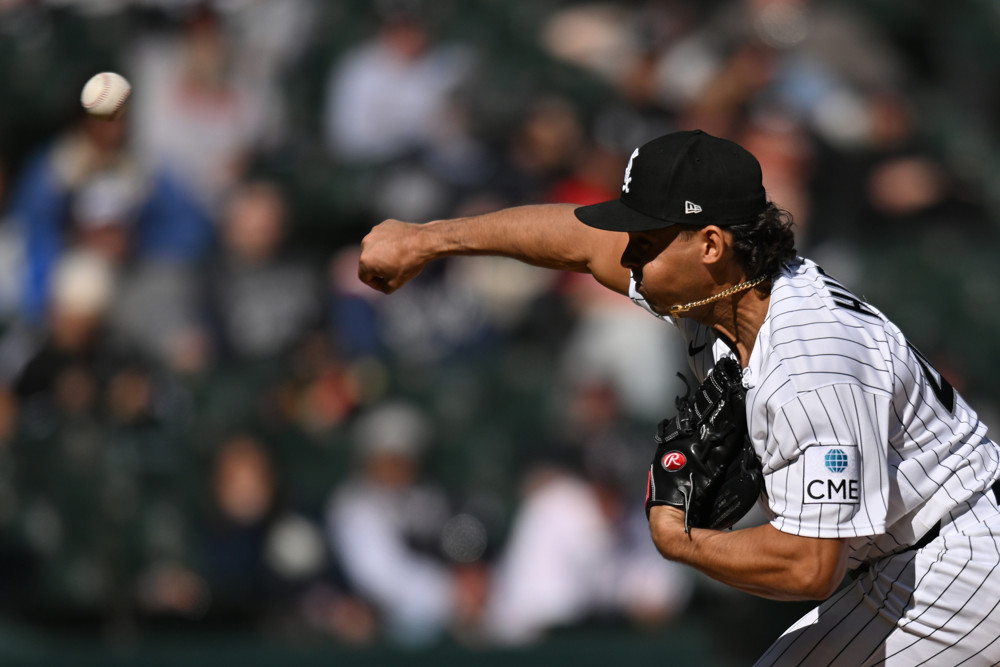
Through seven appearances with the White Sox, Jordan Hicks now has a 8.10 ERA. He's issued seven walks to five strikeouts in 6 2/3 innings of work, and has a whiff rate currently near the bottom of the league.
He feels great.
"I'm in a really good place mechanically, feel like the action -- especially on my sinker -- is really good, sweeper is good, throwing a lot of strikes with both, I feel really good and feel like the contact I've given up is weak," Hicks said. "It's all coming back to me. Last two years, I started in spring training, and then kind've got thrown in the bullpen second half. But from the jump, I've been in the bullpen this spring 'til now, and I feel like it's been better that way, versus just going in, starting the season and getting thrown in there, and kind of being checked out with it. So I feel like I'm really locked in on my routine."
Four of Hicks' walks came in a disjointed first outing of the season in a game that had already gone off the rails. But the 29-year-old right-hander has done a little bit of this relieving thing before, and learned how to separate results from assessing where his stuff and larger game is at.
At 98.6 mph, his average fastball velocity is up a tick from last year early on, his hard-hit rate allowed is 10 percentage points under the league mean, and his Stuff+ readings indicate he still has two above-average weapons to play with, which makes him someone who will get opportunities to distinguish himself in this White Sox bullpen.
"Really good stuff," Will Venable said. "The performance on the field speaks for itself. [Tuesday] he comes out and throws an unbelievable inning, and then we ask him to go back out there because we were a little short in the pen and we needed that and it wasn’t quite as crisp, but I don’t think that’s any indication about where he’s at. He is more of the version of that first inning, where the velocity is really good, he’s spinning the baseball well, really doing a nice job."
Hicks' sweeper, which has ticked up slightly in Stuff+ from last season so far (107 to 109, per FanGraphs) has been a particular focus for where the White Sox feel like they can restore the right-hander to his previous heights as a valuable setup man. Should they pull it off, it quickly turns their trade with Boston into a coup, since -- apologies to Gage Ziehl -- absorbing the last two years of Hicks' four-year, $44 million contract was the real cost the White Sox paid to acquire prospect David Sandlin.
"He’s kind of getting back to that arm slot and sweeper shape that he threw really effectively in St. Louis," said Brian Bannister. "It was arguably the highest whiff pitch in baseball at the time, along with hitting those high velo numbers again. Really just building up that muscle memory where he can go out, under pressure, a high-leverage moment and know who he is, what his identity is, what his strengths are and get off and rip that. Not just going out and -- even though he can throw 100 mph -- throwing seven, eight fastballs to start off an inning. But getting into his mix, trusting it, knowing his arm slot's in the right place, that his body is moving the right way. There’s a very special athlete in Jordan Hicks."
"No. 1 is just giving him confidence to throw it more, whereas in the past he maybe got a little too fastball-heavy," said pitching coach Zach Bove. "Let's throw the sweeper, it's a really good pitch. He's doing a real good job commanding it, which obviously helps. It just gives another problem for hitters. They can't just stay hard, and Hicks throws hard."
Hicks' arm slot has made the rounds over the year, with Statcast having it peak at 48 degrees in 2021, but the 31-degree angle he's at now feels natural to the 29-year-old right-hander. After wondering about the after-effects of moving his release point higher earlier in his career, Hicks feels like he's throwing naturally; from the same slot he'd throw a football if he picked it up and tossed it without thinking.
"Since I've debuted, I haven't really had the same mechanics," Hicks said. "The arm slot, I've been told to go higher and now I'm probably lower three-quarters slot. I feel comfortable there. I think that's my natural slot. Up here [raises arm to model a high slot], I was told to go there, it was 2019 and I actually wound up having TJ, so it might have just been an unnatural thing for me to do. Right now I feel really good."
If Hicks feels this good, perhaps the answer is that he's just not a multi-inning reliever. Venable conceded the White Sox are still figuring out how their bullpen responsibilities will shake out, and hinted that Hicks' second inning of work against the Orioles earlier this week was more of a matter of necessity given all the shorter starts they've been dealt.
"Sometimes there’s just need and you have to do what you have to do," Venable said. "in Hicksy's case -- maybe he’s a one-plus guy, maybe asking two innings from him is asking too much."
Hicks' interpretation of the matter is data-driven, but fairly simple to follow.
"If you look at my history, OPS goes significantly up when my fastball is under 98 mph; so like 97, 96," said Hicks, referring to the velocity he dropped to in his second inning of work on Tuesday. "When I'm 98, 99, 100, 101, the numbers are just crazy different. I only want to be out there when I'm 98 mph and above. It was a 35-degree game and I felt really electric in the first inning. I still feel like I had good action, but they were able to catch up to it. Still weak contact, but they were able to shoot it the other way, versus if I was able to face those same guys in the first inning, I don't think it's the same results."
The framing the Hicks is using is more about why he's still taking positives from the outing despite getting charged for two runs, rather than a complaint about working two innings. In his view, a two-tick velo drop in a second inning of work is standard expectation. He just wants his shift to the bullpen, his comfortable new arm slot, his general good feeling about where he's at physically and mentally to culminate to where 99 mph is the velocity band he declines to in his second inning.
"I feel like I've been available [to pitch] a lot more than in the past, I feel healthier after back-to-back than I have in the past," Hicks said. "I do think there's another gear there. I'm working through some stuff. That's a gear I haven't hit since 2023 when I was in the bullpen. 102, 103 mph, it's something you've got to find again.
"It's not just going to magically happen. I know it's in there and that's why I'm mostly excited to keep progressing throughout the season. I'm stronger than I've ever been, put on some weight and my mechanics are pretty good. So, just trust it'll come."
On Saturday, Hicks was charged with another run after Maikel Garcia led off the eighth by lashing a sinker for a double, and came around to score on a sacrifice fly; essentially a death knell for the White Sox's scuffling offense. He also hit 101 mph on the radar gun twice.