PHOENIX -- White Sox prospect Noah Schultz keeps things pretty concise when discussing his reworked mechanics from this offseason. His 13.8 percent walk rate last season was doubled from the year before, and Schultz will be grading his adjustments by how much they reverse those results.
"Kind of cleaned some stuff up and I'm really happy with the progress we made," Schultz said. "Mainly it's just the consistency of the mechanics. Last year it would get a little wild with a couple, lose a hitter, throw a couple of walks in there. It's not something I was used to in the past."
To an untrained eye, Schultz looks like he's keeping his front side up higher early in his delivery, and in the process of taking that observation up with a trained eye, everything doubles back to the right knee patellar tendinitis that the left-hander rested and rehabilitated after being limited to 73 innings last year.
"He just looked strong on his front leg this spring and he was just dealing with that last year," said Sox director of pitching Brian Bannister. "He wasn't getting the seam shift, he wasn't able to put force into his front leg, he was still growing. There were a lot of variables that on the development side with an extra tall athlete, we're just sympathetic to that stuff and really just gave him the longest runway possible to come back strong and healthy."
Still growing? Schultz is still only 22 and has already needed his height listing re-adjusted to 6'10" earlier in his pro career. How much further is there to go?
"He's way taller than me, that's all that matters," said Bannister, in lieu of giving a specific estimate. "My general rule of thumb is for every inch a pitcher throws, and I deal with a lot of teenaged amateur pitchers, every inch they grow, it takes the brain three to four months to catch up. Because all of a sudden your limbs are different, your hand is different in a 3-D space. There's just challenges that go with the brain catching up with the different size and proportions of your body, so that factored in."
So, while Schultz might be fixated on his 2025 results, the Sox are talking more like they're granting him a mulligan.
⚙️⚙️⚙️
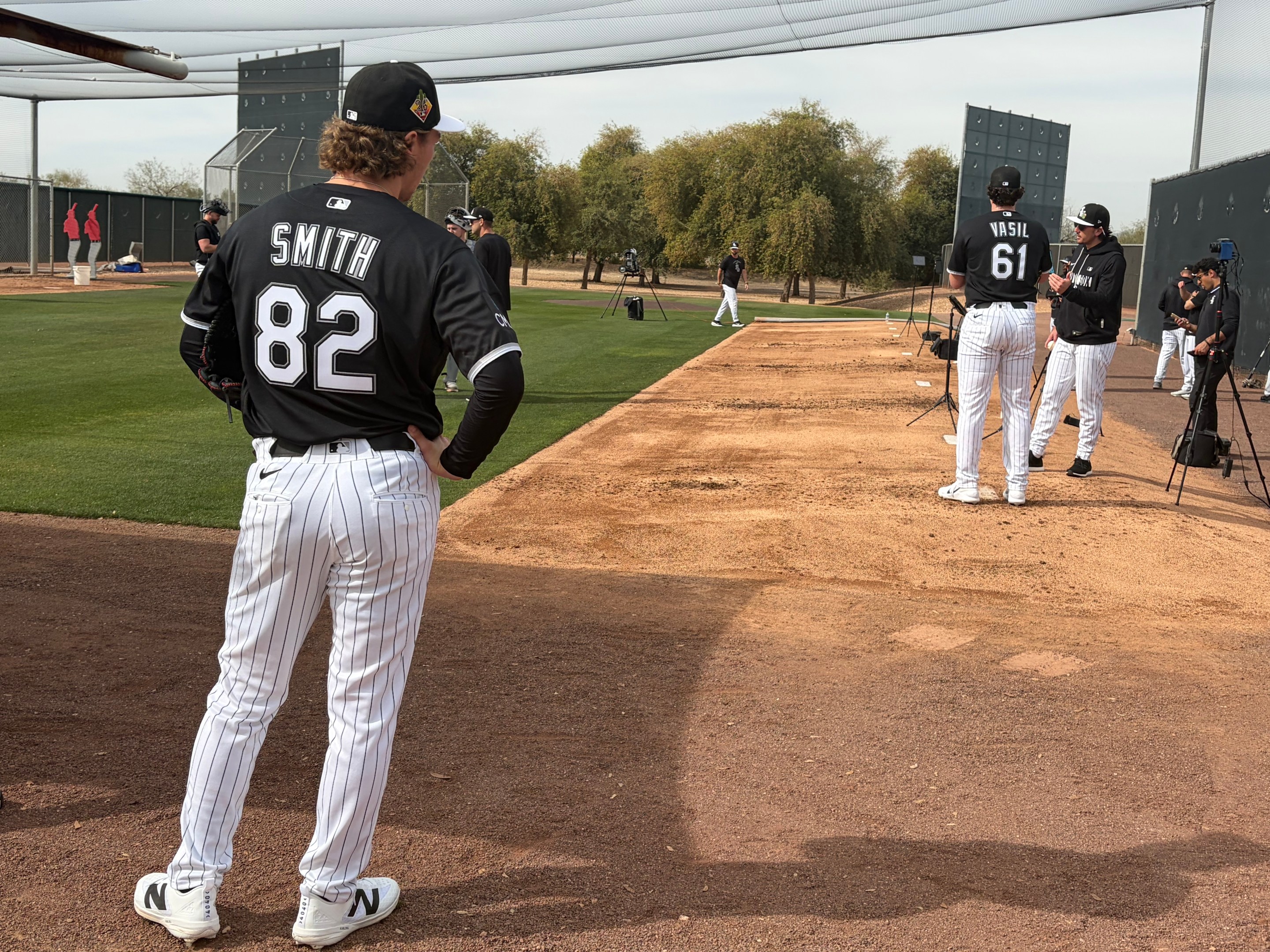
Hagen Smith's crisp 14 innings in the Arizona Fall League (2.57 ERA, 21 strikeouts to six walks) were "super important" to him for closing out an up-and-down first full year in pro baseball in style. But there's two sticking points Smith felt he "hammered" during this past offseason: a tweak to his lower half mechanics to slow his frenetic pace down the mound, and a split-change that comes and goes from his often two-pitch arsenal.
As much as Smith's slider flashes multiple different shapes and speeds, and as much as he's a pure supinator who doesn't have a natural feel for throwing a changeup, Bannister thinks it's inevitable the lefty will need something.
"Power lefties in the league have the capability of going out and winning a Cy Young with mainly two pitches," Bannister said. "But just with how hitters game-plan, it's really important that you give them one other thing to think about. Regardless of how you grade out in Stuff+ models, how often it's thrown, you just have to give them something else to think about which makes them a tick late on the two main pitches."
So why a splitter for Smith? Part of is linked to a delivery that is more rotational in nature and part of it is that just as the league's hitters are adjust to the prevalence of horizontally-moving sweepers, splitters are peaking right now, especially as pitchers successfully importing them from the Pacific Rim becomes more common.
"It's part of the pitching culture over there, they all throw 'em," Bannister said. "Where as US-based pitching development, it's typically avoided. You don't have young amateur pitchers throwing a lot of splitters. It's generally associated with elbow issues. Then all these Japanese pitchers come over and have fantastic splitters that perform like crazy. In the league, everybody knows splitters are the best-performing pitch. They were thrown by the bucket-full in the World Series."
⚙️⚙️⚙️
As an amateur, Tanner McDougal was actually taught how to throw a changeup before he learned to spin either of two awesome breaking balls. But as is often the case, turning over his wrist to throw a change doesn't feel the same after undergoing Tommy John surgery.
"It's been kind of a tough pitch to hone for whatever reason, but it's always something I'm working toward," McDougal said. "I almost over-pronate it, and then it doesn't feel very good. I'm kind of pushing it and my wrist will lay out."
McDougal arrived at camp set upon trying to talk to Shane Smith and Davis Martin for how they found successful solutions, because while he was able to get by against left-handers in his breakout 2025 season by using a fastball-curveball attack, there was enough of a platoon split (.591 OPS allowed to righties, .730 to lefties) that the Sox want to give McDougal something that moves arm-side.
It's just that after Sean Burke's new sinker sapped at the effectiveness of his slider last season, the team wants to move cautiously with McDougal, and not develop a changeup that causes him to use his wrist dramatically different from how it works with his other pitches. McDougal did still strike out 27.8 percent of lefties last season, after all.
"I was with him for his first side in camp and the risk is similar with Sean Burke," Bannister said. "You don't want to get into too much artificial pronation in order to throw a pitch like that, and you don't want him to get into dropping his arm slot in order to create a shape like that. You want to stay in your natural slot, natural hand position, and then we're trying to come up with grips or ways to create something with arm-side viability.
"The one he was throwing was actually really good the other day. He definitely put in a lot of work in the offseason and it's just making sure it doesn't come with a sacrifice to the slider or the curveball, because he does have really high-end spin talent."
⚙️⚙️⚙️
Christian Oppor is actually a natural pronator who has organic feel for a changeup, and actually developing a sweeper that works out of his low slot release was the development breakthrough of his 2025 season (that and maturing into triple-digit velocity). The end result was a 3.08 ERA and 31.7 percent strikeout rate in 87⅔ innings across two levels of A-ball, and even saying that, Oppor was more exciting for his flashes of greatness than overall consistency.
But look where Oppor's front foot lands in his delivery. I had been wanting to talk to Bannister about it since the moment I first noticed it.
He keeps his front toe pointed basically toward the first base dugout (just for a moment), and then crossfires around it. It's weird! Unsurprisingly, Bannister digs it, and not just because it's weird, but rather due to the extra half-second it keeps Oppor's front shoulder closed off from the opposing hitter.
"The lefties that have an ability to stay closed longer than other lefties, and certainly their righty counterparts, it just feels like they have massive deception," Bannister. "If their stuff is equivalent to a righty, it already out-performs, and then if there's a layer of visual deception on top of it, it just plays up that's much more. With Chris Sale, or Carlos Rodón or anybody I've had that has the ability to stay closed -- Garrett Crochet was that way -- it just gives hitters fits."
Despite his readily apparent athleticism, Oppor actually gets well below-average extension. But a uniquely short stride can often wind up being a strange look to give a hitter on its own, and combined with Oppor's distinctly crossfire angle of attack, Bannister is in favor of maintaining something that offers a possibly unquantifiable edge.
"I honestly think it's the last frontier in pitching," Bannister said. "We've solved a lot of things. But the visual deception component and timing deception is far and away what [research and development] departments struggle with quantifying the most, and quantifying it in their models. Between scouts and R&D, it's the hardest component to tackle. So when guys have weird and quirky things, or unique ways they move, or timing cadences in their delivery, those guys become even more valuable."
Like Shane Smith's rushed tempo leg kick.
"It gives hitters fits. [Clayton] Kershaw had the hitch, or Tyler Anderson, give me those types of guys all day long. Because everyone at this point can pitch design. Everybody can quantify the value of pitches in the strike zone. What they can't change is the visual and timing of the delivery that gets the ball to that point. So now it's to the point where the weirder you are, the more I like you."