As the Braves were working on their clinching victory over the Phillies to wrap up the only Wild Card Series that went the distance, Major League Baseball announced the times for the White Sox-Guardians Divisional Series matchup. All times are Central, all games are on TBS:
- Game 1: Saturday, noon
- Game 2: Monday, 4 p.m.
- Game 3: Wednesday, 3 p.m.
- Game 4: Thursday, 4 p.m. (if necessary)
- Game 5: Saturday, 4 p.m. (if necessary)
The Guardians were better off winning the Central and securing the bye because they automatically started one round closer to the World Series, but the White Sox dispatched the Astros in the minimum number of games with a minimal amount of wear. With Jordan Hicks the only pitcher used in both games, and with Davis Martin, Bryan Hudson and Noah Schultz not having appeared at all, the Sox should be more or less rested by Saturday, and for those who won't be all the way back, another off day on Sunday should take care of that.
Barring any injuries revealed by the Sox when they announce their roster today, the effect of the bye is now muted. I was first going to say it's irrelevant, but there's still the matter of home field advantage. It doesn't necessarily show up in the season series records -- the White Sox went 4-2 at home, the Guardians 4-3 -- but more in the fact that seven of 13 games were decided by one run, and four by walk-offs. The Guardians had three of those, so any instinctive recoiling at the sight of Progressive Field can't necessarily be waved away.
⚙️⚙️⚙️
As we began tossing around ideas about how the White Sox postseason roster could surprise -- and in the end, it didn't surprise -- I weighed the idea of Luisangel Acuña being left off simply because there wasn't much evidence of what he could bring to the table, at least in the second half. His main purpose was playing a capable shortstop in order to give Colson Montgomery needed chances at a reset, but he hadn't done anything with the playing time. He hit .197/.222/.262 after the break, but more worrisome was a drop in baserunning activity. After going 15-for-18 swiping bases in the first half, he wrapped up the season going 3-for-6, and there were a couple of occasions where the Sox attempted small-balling him to second instead of letting him try it himself.
Suffice it to say, it was a welcome development seeing him running not once, but twice on the Astros after entering as a pinch runner for Andrew Benintendi in the sixth inning in Game 2. Perhaps it would've been more instructive with regards to his acceleration if the Astros were able to muster a throw either time, but Acuña took second on a pitch in the dirt, and third while Chase Meidroth showed bunt to lure the third baseman in.
Acuña stole 15 bases in 16 attempts in a similar role for the Mets in 2025, so he has it in him to be a real threat, even if opponents are keying on him. That's the one thing he does better than anybody else, and if it's back, then it's another example of this roster being as compatible as a 26-man roster can be in October.
⚙️⚙️⚙️
As for Meidroth squaring around to bunt, it wasn't entirely a ruse. Will Venable discussed it after the game, saying Meidroth was going to pull back a first effort, but the strategy might have been called upon had the double steal not been so easy for them.
We were first and second, they made the pitching change, and we just talked about, you know, do we want to bunt Chase or do we want to go ahead and try and steal these bags. And we went with let's go ahead and be aggressive and steal the bags, have Chase show bunt, pull back, if we don't get the steal, then would he go ahead and bunt.
But they were able to get the steal after the inside move there. Acuña did a great job. Peters, I believe, on the back side [...] Both of 'em did a great job advancing, then obviously Chase worked a 3-1 count and the rest is history.
The play reminded me of a situation on Friday against the Rockies with Kyle Teel at the plate with runners on first and second and nobody out. Like Meidroth, the goal was to add insurance. Unlike Meidroth, Teel had the handedness advantage against Juan Mejia, so it seemed more obviously conservative to see him square around so early.
He pulled the bat back twice as the Rockies brought in the corners, then spanked a single up the middle against an altered infield alignment. The White Sox won that game handily and so the play didn't really register as part of postgame questions, but I'd wondered if it was a similar ploy for rearranging the positioning, or after two attempts at conspicuous selflessness, somebody on the staff had to remind Teel that he should be swinging away in that situation.
⚙️⚙️⚙️
The White Sox accomplished their main objective on the pitching side of the Wild Card Series by keeping Yordan Alvarez in check. He went just 1-for-8 with two walks and two strikeouts over the two games, and when combined with Pete Crow-Armstrong's 0-for-7 performance against San Diego, it was a tough two series for both leagues' presumptive MVPs.
The Sox did it two ways:
- Their lefties were safe with their misses.
- They got a little lucky.
Regarding the first point, here's the pitch map for everything the White Sox's southpaws threw at him.
Very little was over the plate, and only one pitch was up, but Sean Newcomb was able to get him to bounce it into the ground at Chase Meidroth for a routine 4-3.
Now, Alvarez still hit the ball hard -- four of his six batted balls clocked in at over 100 mph, and only one was shanked -- which is why you have to chalk some of it up to fortune.
Anthony Kay's lone tangle with Alvarez best represented the overlap between "good" and "lucky." With runners on first and second and one out in the fifth inning of a 4-3 game, Will Venable called upon Kay to retire Alvarez, as pitching around him would load the bases for righties as far as the eye could see.
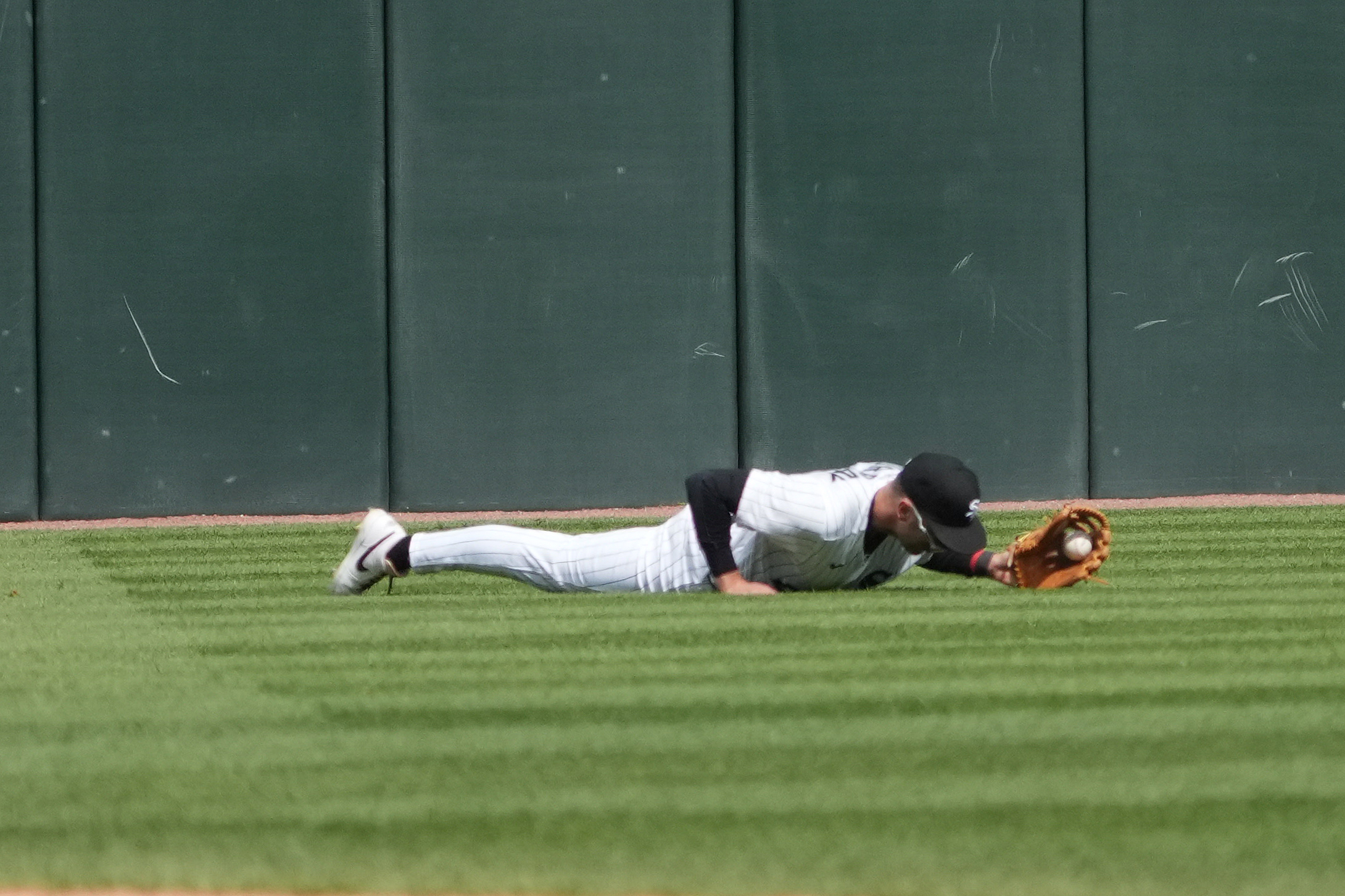
Kay nearly fumbled the assignment by falling behind 3-0, but he got back in the count by spotting a 96.6 mph sinker on the outer edge, then threw an even harder sinker (97.5 mph) in an even better spot, on the low and outside corner. Alvarez put a decent swing on it, directing a 97.5 mph liner toward the Crawford Boxes, but it had more slice than carry, and Sam Antonacci was able to round it off on the warning track without much issue for a key second out.
It was an important appearance for Kay, not just because he preserved the lead, but because he stepped up in a role to which he was not accustomed. Kay led the White Sox rotation in games and was second in innings, but despite his reliability in taking the ball, he was still the guy tasked with starting a meaningless Game 162, leaving him theoretically the least available of any pitcher on the White Sox postseason staff.
That said, he still got in the game at a key moment while three other White Sox pitchers went unused during the series, and after the game, he talked about the way he's reframing a postseason role that might not be exactly what he'd envisioned.
“I kind of knew that I was gonna be in the pocket to face (Alvarez) and the guys after him, and I feel like we kind of did a good job against him in the regular season, a couple series that we faced him,” Kay said. “To be able to hold him to nothing, that’s kind of the key to (facing)that lineup, and we did a pretty good job of it.
“At this point in the year, you’ve gotta take your egos, put them to the side and just do your job. No one’s gonna throw a complete game out here. Everyone’s gonna get their guys, get their pocket in the lineup and keep it moving, hand it off to the next guy.”