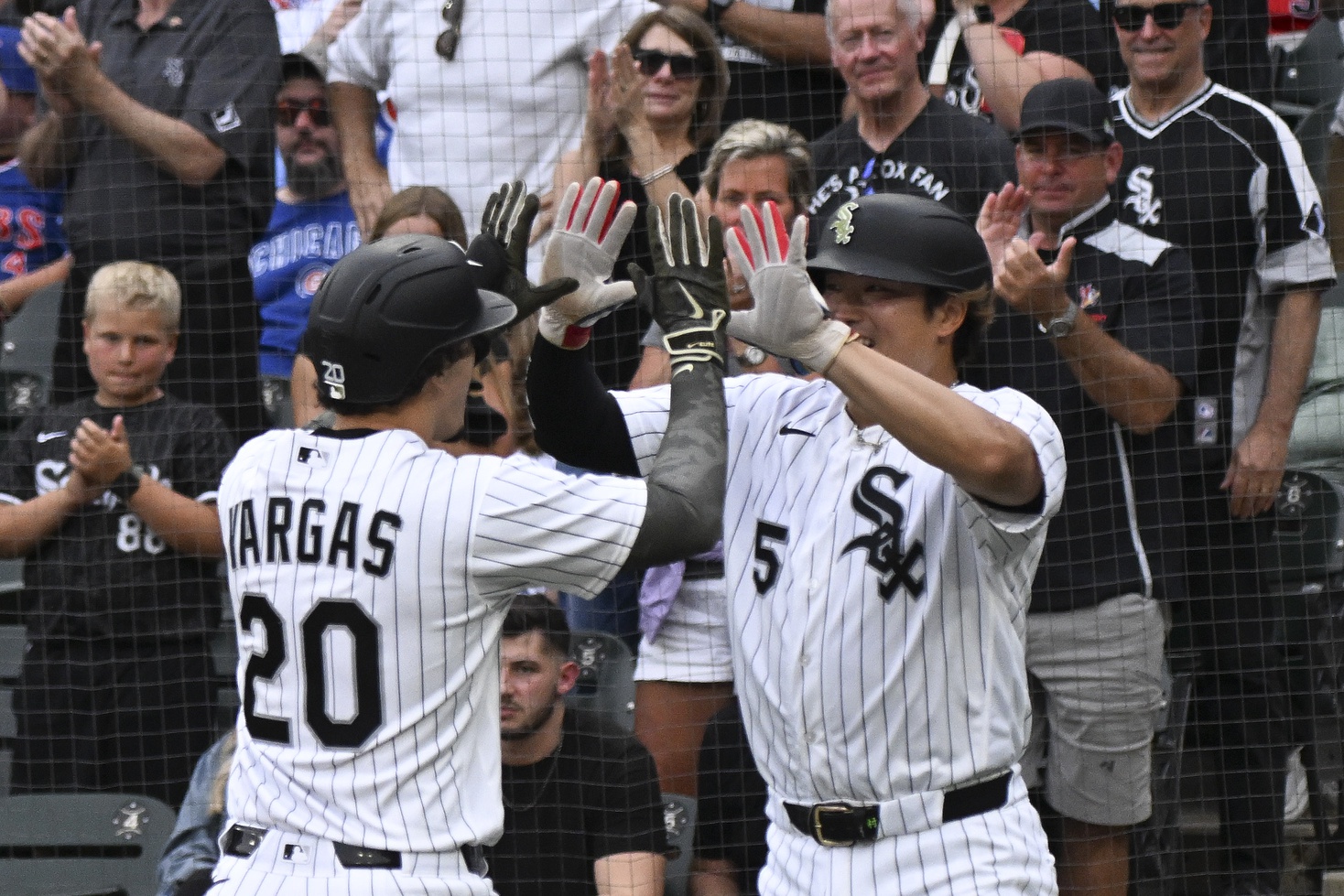
While surprising, it was easy to comprehend the White Sox as a top-flight unit when Munetaka Murakami and Colson Montgomery were on 45-homer paces during the first half. It was a little harder to understand how they maintained their grip on the American League runs lead when both sluggers slumped after the break, Sam Antonacci went homerless over the final 50-plus games, and Braden Montgomery eventually looked like a rookie.
It became a little bit easier to understand after the final regular season game was played, and various baseball writers started sifting through the leaderboards and looking askance at what they saw.
Ignoring strike years/2020....316 average is lowest to lead the majors ever45 homers is lowest total to lead the majors since 2014116 RBI is lowest total to lead the majors since 2014119 runs scored is lowest total to lead majors since 201440 doubles is lowest total to lead majors since 1972
— Matthew Pouliot (@matthewpouliot.bsky.social) 2026-09-28T00:27:05.016Z
Qualified hitters with a .900 OPS2019: 292020: 232021: 142022: 52023: 102024: 92025: 62026: 3 (Alvarez, Crow-Armstrong, Wn. Contreras)Tied with 1976 for the low total of the live-ball era.
— Matthew Pouliot (@matthewpouliot.bsky.social) 2026-09-28T00:37:29.865Z
Bauers was great, but is anyone else bumping on ".269/.389/.484" landing as the second-best hitter in the National League? Fix yourself, baseball.
— Joe Sheehan (@sheehannewsletter.bsky.social) 2026-09-28T02:30:28.058Z
This also carries over to team leaderboards, at least in the American League. The White Sox might have led the AL in runs scored by 37 runs, but their 776 runs was the lowest league-leading total since 2014, when the Los Angeles Angels led the way with 773.
The National League had four teams over 800 runs, so the offensive output was a little healthier over all of Major League Baseball than the AL leaderboard lets on, but even then, the gap between the most effective offense and the league-average offense was the smallest since the late 1960s.
Barring an unlikely overnight change, the Cubs led MLB with a 110 OPS+. That is the lowest figure to lead MLB since 1969 (Orioles, also 110).
— Joe Sheehan (@sheehannewsletter.bsky.social) 2026-09-28T03:20:20.781Z
In this context, it makes sense that a White Sox offense with visible flaws but enormous strengths would balance out to not just be a net positive, but lead the league in runs scored. This is an environment where the Mariners lost 100 runs and the Blue Jays lost 150 from last season to this one. I'm not sure baseball abhors a vacuum because the combination of rising velocity and improved defensive positioning only makes stacking hits harder, but with two postseason favorites foundering, there was room for some team to step up and distinguish itself with thump, and the White Sox had the initiative and talent to see it through.
With that in mind, let's take a look at how this White Sox offense compared to its previous iterations, and against the league at large.
Runs scored: 776
- Last year: 647
- Most since: 2021 (796)
While Tony La Russa's squad scored 20 more runs, the league context wasn't as impressive, as those White Sox finished fifth in a top-heavy AL, the last of the five above-average offenses. The Astros paced the league with 863, which was one reason why that postseason series was daunting on paper, and proved out to be in practice. The 2026 White Sox and Astros have flipped places on the runs leaderboard, as Houston finished fifth in runs with 734, but as you'll see at the bottom, there probably isn't an edge.
Batting average: .236
- Last year: .232
- Best since: 2023 (.238)
You even have to be more cognizant of league contexts when looking at the rate stats, because while a .236 batting average is unimpressive on its face, it only lags five points below the AL batting average of .241, as the Tampa Bay Rays were the only team to hit above .250. While the 2023 White Sox hit for a better clip, it was one spot worse in the league rankings (12th), and further away from the top of the leaderboard, as seven teams hit .250 or higher.
On-base percentage: .320
- Last year: .302
- Best since: 2021 (.336)
The lower batting average has effects downstream, as lower batting averages fuel lower OBPs, but an 18-point jump still has a big-time impact. The White Sox went from tied for 12th to third.
Slugging percentage: .406
- Last year: .373
- Best since: 2021 (.422)
The lower batting average also saps the slugging percentage, as a .406 SLG was only 10 points better than the league average. But it's a 33-point jump for the Sox from 2025 while the leaguewide slugging percentage dropped 10 points, so the relative improvement played up.
Home runs: 211
- Last year: 165
- Best since: 2012 (211)
The 2012 White Sox also couldn't see a surprising run at an AL Central title through the finish line, but at least the expanded postseason offered these White Sox a chance at October baseball.
Walk rate: 9.5 percent
- Last year: 8.3 percent
- Best since: 2021 (9.6 percent)
It surprised me that the 2021 White Sox were slightly better at drawing walks, but that was the last year that patience was a part of Yoán Moncada's game, and so he paired with Yasmani Grandal to give the White Sox two big sources of bases on balls. If it feels like the 2026 White Sox were unusually disciplined by franchise standards, it's more evident in the chase rate. FanGraphs has the White Sox swinging at 31.2 percent of pitches out of the zone, the lowest since 2010 (29 percent).
Strikeout rate: 24.1 percent
- Last year: 22.8 percent
- Highest since: 2019 (25.6 percent)
Given that the White Sox had the two most strikeout-prone qualified hitters in the game, and by a sizable margin...
- Colson Montgomery, 35.6 percent
- Munetaka Murakami, 35.4 percent
- Austin Riley, 31.9 percent
...it's surprising that the White Sox only had the fifth-highest K-rate in the majors. That's what all that platooning helps cover up.
wRC+: 104
- Last year: 89
- Best since: 2021 (108)
The good news: The White Sox improved from fourth-worst to fifth-best in the majors in terms of overall effectiveness, and No. 2 in the American League. The bad news? The one team ahead of them is the team they're playing in the Wild Card Series. It's not quite 2021 all over again, but the Houston offense figures to keep the White Sox pitching staff honest, and it's up to the White Sox lineup to reciprocate.