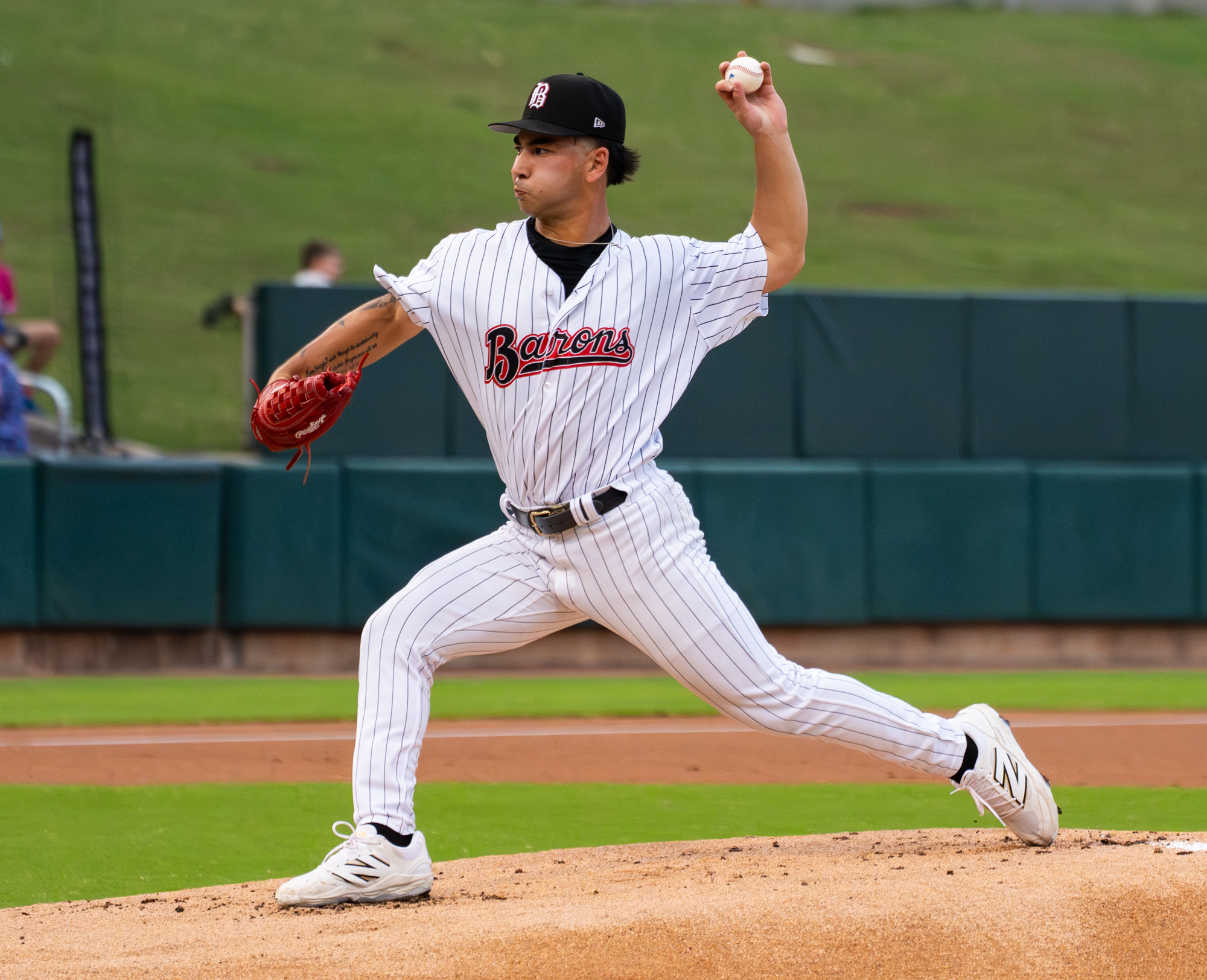
BIRMINGHAM, Ala. -- Lucas Gordon's relatively smooth ascent through two levels of A-ball were marked by an ability to trade walks for hits. He limited hitters in the Carolina and South Atlantic leagues to a .180 average in 2024, and followed it up with a .214 average allowed in a season split between Winston-Salem and Birmingham, mitigating any effects of an inflated 11.6 percent walk rate.
Still, it's not a balance he's comfortable striking.
"I actually hate walks," Gordon told Sox Machine last week at Rickwood Field. "I hate walks, and I think that's the one thing that's kind of holding me back right now in my own head, and that's very controllable."
Starting a season at Double-A for the first time in 2026, a livelier Southern League is imposing the first real cost for that same walk rate. The league is still hitting just .219 against him, but while he allowed 10 homers in each of his first two seasons while throwing 113 and 107 ⅔ innings, respectively, he's already given up nine homers over 52⅔ innings this year. Consequently, his 5.30 ERA is nearly double the professional ERA with which he entered the season (2.80).
"It's mainly just him understanding that he doesn't always need to try and go for a chase," said Birmingham pitching coach John Kovalik. "Especially before two strikes, just empowering him and making him understand that his stuff really does play in his own.
"And when he does throw in his zone, you still get swing and miss within the parameters of the box. So just him just continuing to reinforce that understanding with him has been very important. Especially lately, a lot of the runs that have ended up crossing the plate have reached via free pass, so we're definitely trying to limit that through some more targeted delivery work and just again, just making sure that he's in there, an aggressive mindset, understanding his stuff plays in the box."
Gordon's stuff is led by a plus changeup with a 12-13 mph disparity from a fastball that sits 91. He used it extensively against a righty-heavy Pensacola lineup last Tuesday, and even hitters that know to anticipate it struggle to time it.
When asked how he throws it, Gordon said, "You know what? I look up and I say, 'Thank you.' That pitch is a pitch has always been there, and every time I try to show someone how I do it, it's always terrible."
But he did offer an explanation of the mechanics behind it.
"I grip it very, very loose. Like if I were to turn my hand over, it's pretty much falling out," Gordon said.
"I grip a four-seam fastball, and then I put my ring finger over where I grip it, and so only my ring finger and pinky are on the ball. So it's kind of very unstable, but I think that kills a lot of the velo, and I can just throw it as hard as I want."
The White Sox selected Gordon in the sixth round of the 2023 draft after winning Big 12 Pitcher of the Year with Texas, and the changeup led the scouting reports. Like many offspeed artists, however, the search for a reliable spinning pitch has been elusive to the point that Gordon remarked, "I thought I was going to die without a breaking ball."
This is the season he's trying to tackle the issue head-on.
"It's hard to spin a baseball for me because I'm such a heavy pronator," Gordon said. "I literally couldn't spin a baseball until I met that guy [nods toward a passing Kovalik], and he taught me so much. Now I have, it's been a really good slider, and he taught me a cutter, which I never thought in a million years I'd be able to throw."
When the slider works, Gordon calls it a bullet version that plays well off his changeup, as they're the same speed with different movement profiles. The cutter is a distinctly firmer pitch, with the goal of throwing it 87-88 mph in on the hands of righties for quicker outs, because even successful Gordon starts involve a few more pitches than preferred.
However, his pitch mix evolves from here, two things remain consistent: the changeup will be at the center of it, and he'll need to spot more strikes with everything.
"I think one thing with Gordo is through his type of profile, his command needs to improve," Barons manager Pat Leyland said.
"He has his safety net with the changeup, but as he's climbing levels in order to continue to have success, the walks need to be limited. And not just the walks being limited, but the command needs to tighten up a little bit. Now he certainly has control, but for his profile, he's got to be able to put the ball where he wants to."
⚙️⚙️⚙️
Hagen Smith's most recent outing -- 5 IP, 4 H, 2 ER, BB, 7 K, 82 pitches -- was his longest and most efficient of the year to date, with a season-high in strikeouts and notably strong control from someone carrying a 16.7 percent walk rate in Triple-A. But Smith wouldn't characterize himself as someone who's been searching for a breakthrough.
"Obviously there's some times this year and last year where I haven't thrown the ball the way I wanted to," Smith said in a phone interview with Sox Machine. "But I think it's just about going out there and doing it. I feel really good right now where I'm at, and am just going to keep going out there and competing."
So he's seeing a lot of good results from a recent tweak to raise his still fairly low arm slot -- better control, holding his velocity deeper into games -- but views the cross-organization effort, from Knights pitching coach Scott Aldred to pitching director Brian Bannister, as just restoring to a place his delivery has gotten to a few times already in pro ball, notably the Arizona Fall League.
"I'm used to throwing like that, and it kind of got away from me for a little bit, but now we're climbing back into it, so it's really exciting to see," Smith said. "Just trying to get back to when I'm going best on the mound. Every single day you have to work on it until it becomes natural and it's just what you do."
Unless you force him to expound upon it, Smith would sum up his key to success as simply "get ahead in the count," and maintenance of his arm slot looks like another plank in the platform of throwing enough strikes for his nutty swing-and-miss stuff (69.4 percent contact rate) to play up.
Smith feels his other physical cue of dropping forcefully into his back leg has been more consistent of late; allowing that perhaps it's working in cohesion with his arm slot, and perhaps he's just benefitting from thinking about it less. And he's really settled his arsenal into a mix of fastball-cutter-slider with just the occasional splitter, with the cutter really emerging as a pitch he can use to get back into counts.
"I'm starting to get comfortable with it and I really like throwing it," Smith said. "For me, strike one is the biggest thing. We always talk about it, me and Scott Aldred. Going out there and just really trying to attack that plan of just getting ahead of hitters and being in advantage counts every at-bat."
It's been a slow climb up to 38⅔ innings so far this year for Smith, who says there are no specific workload targets for him after covering 89⅔ innings in 2025. But the former fifth-overall pick he says he feels good physically, and the organization's stated goal was to set him to finish out the year without interruptions. So when Smith gets his mechanics, and relatedly his control, in line to merit a call-up, it's full, unfettered rotation spot he's working to put himself up for, on a team that's not just ushering in a youth movement but competing for a playoff spot.
"Everybody in the organization is really excited to get up there and help the team as we can," Smith said. "They've been really fun to watch, the games we can catch. They're playing really good baseball right now."
⚙️⚙️⚙️
Tanner McDougal sounds bored.
"I'm tired of not being on the field," he said via Zoom on Monday. "Hopefully once I get back and rolling again, I can add to the success, and help the team hopefully chase a division."
But sidelined with a flexor strain that has already cost him a month and figures to keep him out until hopefully some rehab starts by the end of June, McDougal does not sound despondent.
His throwing progression has already begun, and while there are certainly notes of frustration with himself that his flexor strain -- in his view -- stemmed from him compensating for a slight hamstring strain in his previous start, McDougal ultimately feels he's following the same recovery path of his good friend David Sandlin.
That guy is in the majors, and that's where McDougal believes his stuff is capable of being, based on the one month sample he was able to collect at Triple-A (24 IP, 12 H, 13 BB, 27 K).
"When I don't have my best days, it's because I'm nibbling and I'm not just going at hitters," McDougal said. "The best thing for me is just to try to literally throw everything down the middle and let it play. I'm not going to be a guy who's going to paint corners and, dot i's and cross t's with my stuff. I just try to get after it in the zone and see what happens."
Such an approach requires absolute confidence in his stuff, and while it's easier to talk it than enact it -- especially while sidelined -- McDougal's curveball and slider piled up the nutty miss rates in Triple-A (57 percent each, per Synergy Sports) to justify some bluster. He feels the curve had been inconsistent in his opening month, and the slider grew to a bigger size than he's used to, even if it remained effective. Nevertheless, McDougal has a three-pitch core identity he's grown comfortable with. His changeup and two-seamer are tertiary concerns.
With good health and barring setbacks, McDougal hopes to have two to three rehab outings in the can by the time the All-Star break arrives, and be nearing full-strength for the second half. No one wants to hear injured players like McDougal, Kyle Teel, Munetaka Murakami, or even Mason Adams and Drew Thorpe sold something akin to trade deadline additions. But for those individuals, the White Sox's promising starts does provide some extra juice.
"They're fighting for the No. 1 spot in the division now, which is sick," McDougal said. "In any way that you can help to lift the team, you want to do it. It's definitely motivating."