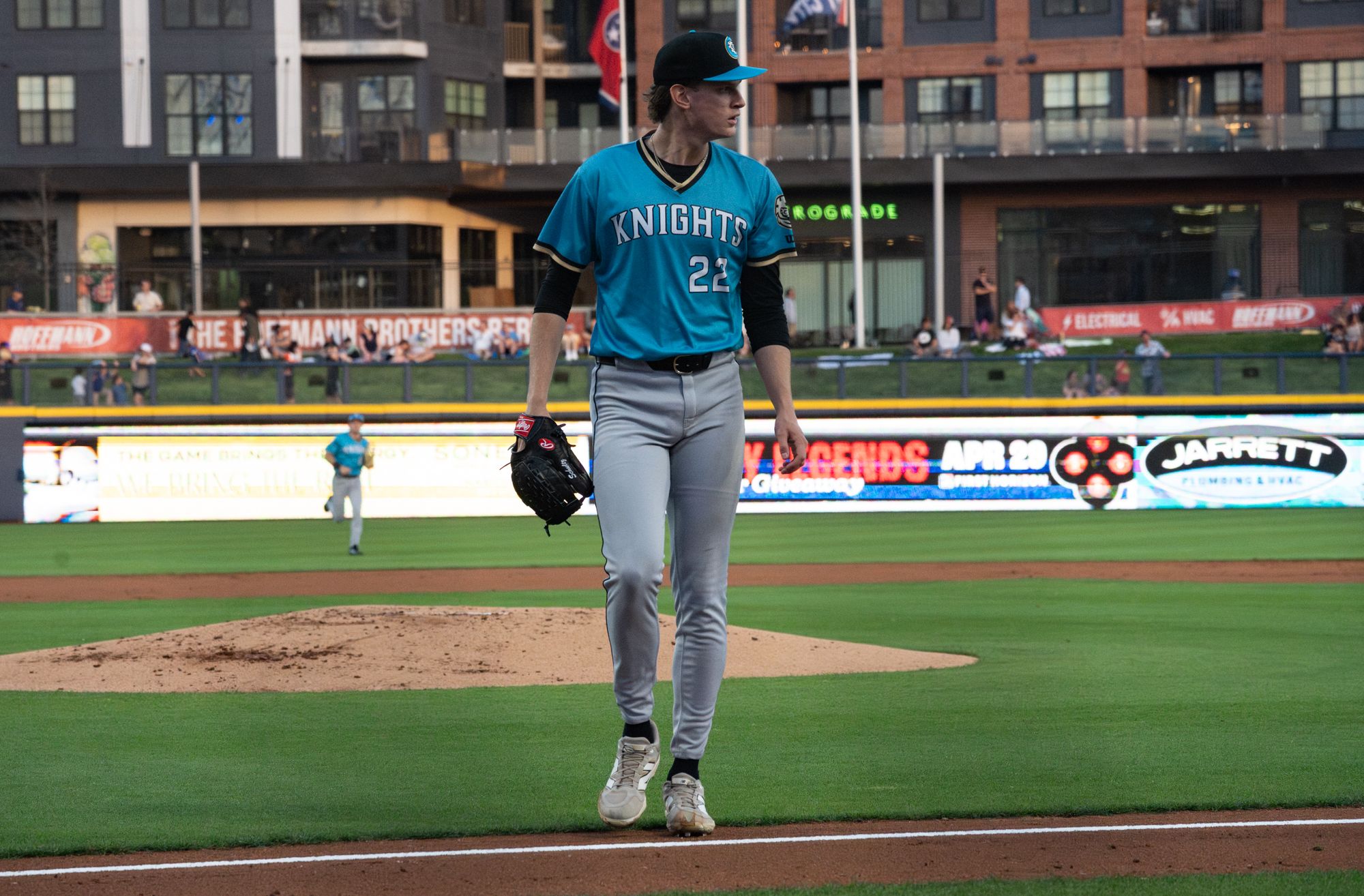
Mark Sheehan did not see stardom when Noah Schultz first walked through his door.
"I had no idea," said Sheehan, who has coached Schultz since he was 14. "He was 5'8", 130 pounds, skinny and gangly. You could tell by the way he threw it, with his arm path and stuff, oh, there might be something there. Then, as he started when he grew with a foot in, like, two years, you could see the velocity going up."
On Sunday night, when Sheehan's phone buzzed as he was out to dinner and he saw it was Schultz calling, he had a more specific idea of what to expect. The longtime pitching instructor has relocated to South Florida after his days of working with a teenage Schultz out of his facility in Naperville, but that didn't affect how well his eyes work. He knew his pupil's first three starts of the year -- especially the last one -- were sensational, and back to normal.
"He was going to pitch Tuesday in Jacksonville, so I was going to drive up and see him," Sheehan said. "He goes, 'Change in travel plans: You're going to Chicago.' And I was just like, you know, screaming into the phone."
Part of the benefit of Schultz spending his offseason training at the Boras Corporation facility in South Florida is that it positioned him to once more work regularly in-person with Sheehan. The Tom House-trained instructor who taught Schultz to embrace his natural low slot and throw with his shoulders and eyes level has always stayed in touch, with the left-hander regularly sending him video and data after every outing, spurring conversations that resembled detective work during an injury-marred 2025. All the tweaks and remedies that Schultz was shuffling through seemed like they were trying work around the elephant in the room, to the point where Sheehan now views the final season-ending twinge in his client's right knee as a blessing in disguise.
"I'm like, 'Dude, nobody can pitch on one leg, especially if it's your front leg,'" Sheehan recalled. "Nothing was right. His slider wasn't moving right, the velocity was dropping. He was like 77-to-80 mph with it, which it's always better when it's 83-to-85 mph."
Three to four times per week starting last November, Schultz would bounce over from a couple hours of strength training at the Boras facility first thing in the morning, to meet with Sheehan about 20 minutes away and slowly rebuild the delivery that took the minor leagues by storm. Working together in person again, Sheehan was struck by the maturity of his now 22-year-old student -- the professional-level commitment to his physical routine, how relaxed and carefree he seemed, how much more open and informed he was with his feedback -- which helped ease the unique challenge that Schultz's outlier physicality has always presented.
First window is prepubescent. Second window comes with testosterone/hitting puberty. https://t.co/R519dNUTWN
— Tom House 〽️ (@tomhouse) December 8, 2021
One of the Tom House teaching concepts Sheehan really values is "windows of trainability," which could be crudely summed up as being cognizant that young pitchers need time for their neurological system to catch up to their physical growth, and certain skills and instruction can't really be installed until specific stages of process are complete. Not only did Schultz have a massive growth spurt in his teens that already forced some of these windows to get merged, but he's only kept growing, even as he neared the doorstep of the majors. (His height has already been revised upward once to 6'10", but Sox personnel has said he's grown yet another inch.)
That, along with rehabbing from an injury, required a cautious process.
"Typically at his age, he's in the fourth block ... but because of his continued growth, I was really conservative in the beginning," Sheehan said. "I kind of added a little bit of everything. Window one, window two, window three and window four."
Schultz's knee wasn't quite 100 percent yet when the pair began working together in November, so a lot of their early focus was on mechanical tweaks they could accomplish through patterning work that didn't involve throwing. Everyone agrees the fundamental issue for Schultz's ugly 2025 season was his lead leg not offering stability, but the downstream effects needed to be ironed out of his muscle memory. Sheehan felt Schultz motion with his glove arm had become long and out of sync with his shorter arm action, which served to tilt his shoulders, and they used drills that had the left-hander with a towel, a ball, or even his glove in his throwing hand to restore his balance.
Sheehan is a big proponent of the very straightforwardly-titled online module ArmCare.com, which typically requires weekly measurements to spit out a personalized program based on a player's physical attributes. Instead, Sheehan tested Schultz three times per week, which he admits his pupil grew tired of, and mapped out a program that would have him start throwing low-intensity bullpens before Christmas -- just as he was increasingly having days where he didn't feel his knee at all -- and returning to full intensity after the holiday break. As he recalls Schultz's first bullpen was actually pretty rough, as was the case at the outset in spring training, but both came when there was still ample runway for a laundry list of tweaks to get knocked out.
"Once he kind of locked in, we had to make other little adjustments, like his setup," Sheehan said. "They had changed his setup. We went back just to [pitching out of] the stretch, brought his feet a little closer together. I had him tilt his upper body over, just a little bit over his toes. That's when he starts saying, 'Yeah, this feels normal. This feels like the way it used to.' So we used a little bit everything; strength, neurological skill, speed, throwing. As the months went on, our training sessions would go from an hour, and then some days we'd be there two, two and a half, maybe three."
One of Sheehan's favorite stories of working with a teenaged Schultz is the first time he showed him a projection, based on broad jump testing and other assessments, that he would one day throw 98 mph, and his student's eyes bugging out in excitement. But other than using Trackman data to measure Schultz's slider shape returning to its norms, he emphasizes that he does not bludgeon his clients with data, especially the younger ones.
"For a 13-year-old, none of that shit matters, No. 1," Sheehan said.
Declining to have the elite pitching prospect recovering from a knee injury do a broad jump test was more of a common sense decision, for example. This process was more about restoring Schultz to feeling comfortable and returning to his norms, which have become less alien across the league in the four years since he was drafted. Looking back at old questions I asked of Sheehan about whether a pitcher with Schultz's weird arm slot could hold up in a rotation feel cringeworthy now. Glancing around the league, Sheehan notes Paul Skenes and Zack Wheeler throwing with their shoulders level throughout their delivery and sees it as a sign progress.
"That's something that Tom House has been talking about for 30 years, and it's just something I do with every kid that I work with that's the first thing we address is their posture," Sheehan said. "We're designed to throw with our shoulders level; that allows your body to transfer all those forces from the ground, to your legs, to your hips, to your shoulders and into the baseball. When your shoulders are level, you do it more consistently. I have a term, we call it 'throw hard easy.' It feels really easy when you do it that way, and that's the way it's supposed to feel."
So while Schultz's prodigious growth seems to have disobeyed House's window of trainability model, Sheehan sees him as the exception that proves the rule. The knee injury strikes him as an echo of the aches and pains Schultz would acquire as a teen undergoing a massive and rapid growth spurt. He's not sure it will be the last hiccup in the physical maturation of this giant from Oswego, Ill., but it's also cause to update the projection he put on his velocity all those years ago.
"I really think what's going to happen is when -- maybe, I think next summer, he's going to be sitting 97-to-100 mph, maybe a little more," Sheehan said. "I think they're still looking at more mph, and I know there is, because of what I see with our measurements."
That's exciting enough on its own, and Schultz is obviously an immensely physically talented prospect with the potential to become the greatest pupil Sheehan has ever coached. But when he talks about why Schultz's debut is a special moment in his life and career, the topic switches to the personal.
"The difference, what really makes Noah who he is today, is his personality when he gets the ball in his hand on the rubber," Sheehan said. "He's cool as a cucumber when he's at the academy or around friends, but when he steps on the mound, there's a different animal in there, and I think that's what makes him so good. I think last year might have actually been good for him, because he's never experienced failure."
"He gets pretty fired up out there. He doesn't display it like others, but you'll see him shake his hands down, like 'fuck yeah!' when he's walking off the mound, and it's just funny. Because he's definitely not like that outside of the game."