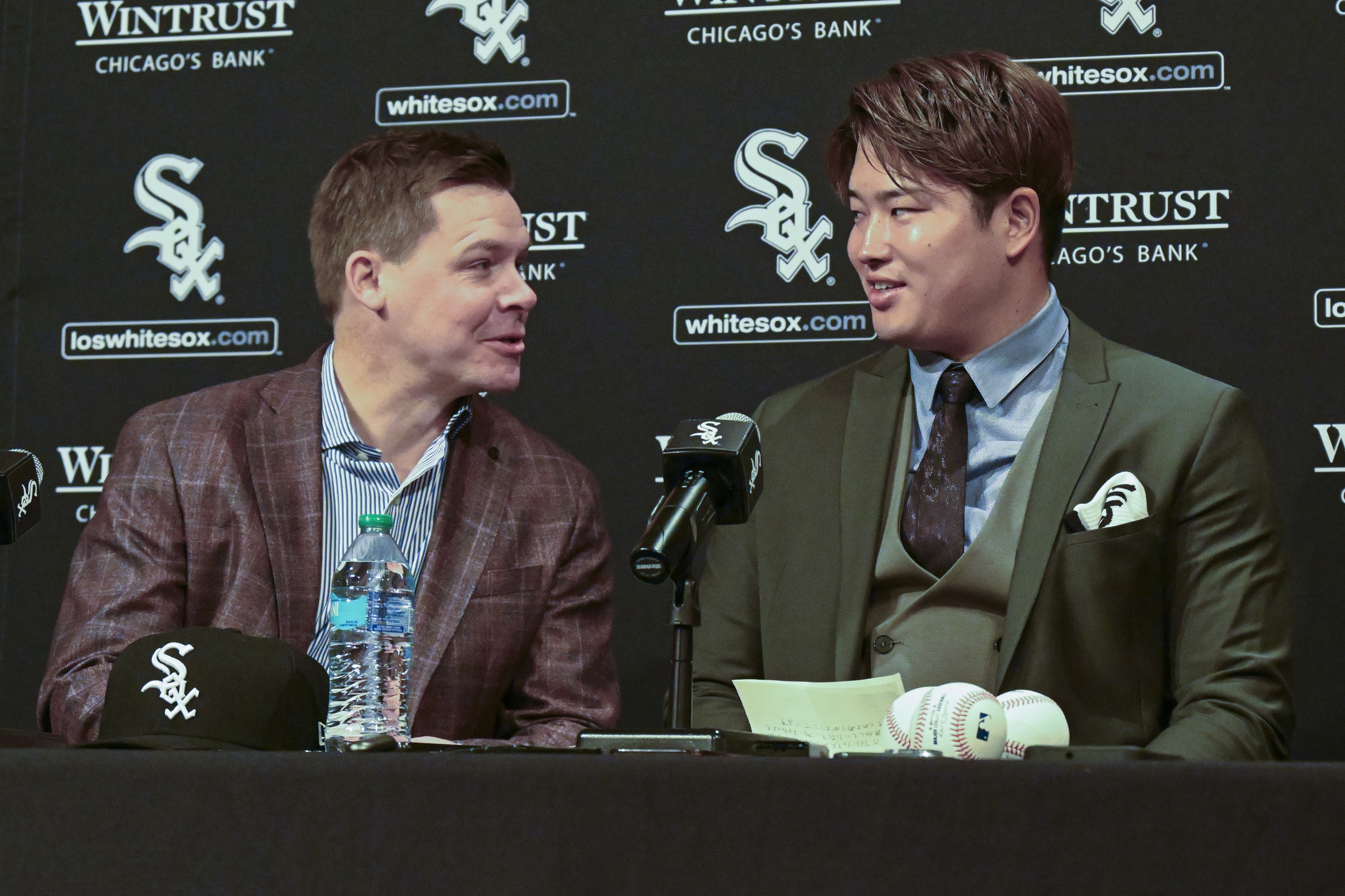
If there's an air of disappointment to the impending Seranthony Domínguez signing, well, it's because it's a significant signing the White Sox could afford, and when it comes to the White Sox's version of "ponying up," you'll probably have more success betting the under before you even learn the who, what and how much.
More specific to this particular transaction, the Sox have a rich recent history of prioritizing relievers before the more important parts of the team, and the timing of Domínguez signing to a $20 million contract right after the White Sox shed a $20 million salary -- even if the 31-year-old right-hander’s money is spread over two years instead of one -- made it feel like the White Sox saw it as the superior use of those specific resources.
In the middle of the most dismal stretch in the franchise's unimpressive history, it's cynicism, not enthusiasm, that has to be tempered, and that's the case here. Last year's bullpen could have very well turned Will Venable as bald as he was during his college days, so the offseason was likely to produce a reliever of consequence. Had Pete Fairbanks chosen Chicago instead of Miami last month for a higher AAV than Domínguez signed for, nobody would have blinked, which is fitting since Fairbanks doesn't, either.
I'm of the mindset where every team could -- and maybe should -- have at least one relief investment of note, because it reflects an amount of attention paid to the unit. Dwight D. Eisenhower wasn’t thinking about bullpens when he said "plans are worthless, but planning is everything," and the stakes of the late innings of midseason White Sox-Angels games are just a little bit lower than what he weighed in the European theater, but the amount of volatility is comparable. Spend too little, and you might spend the entire season struggling to define a hierarchy because unproven arms struggle to pitch above their pay grade, which is what happened with the White Sox last season. On the flip side, the 2023 White Sox allocated a staggering $44 million to the bullpen of a team that lost 101 games because the rest of the roster was too deficient to provide leads. They also still finished 28th in save percentage.
As the White Sox are presently constructed, they have Domínguez at $10 million and (assuming he's not the fifth starter) Sean Newcomb at $4.5 million, followed by six guys making the league minimum, more or less. That brings you to about $20 million, which is roughly the cost of the average bullpen, and it seems like a template for responsible relief spending going forward. They've allocated enough money to open the season with at least a couple ideas for how the late innings will work, so the first failure won't constitute an out-and-out emergency for a coaching staff that already has enough on its plate. It'll only turn into a White Sox Thing if they continue to funnel Robert dollars in this direction.
⚙️⚙️⚙️
The bigger question hovering over the Domínguez signing is whether the White Sox will convert on a bullpen investment in a fully satisfying fashion. Here's the list of the team's free agent reliever signings since the close of the Second Rebuild:
| Pitcher | Contract | G | IP | ERA | bWAR | fWAR |
|---|---|---|---|---|---|---|
| Liam Hendriks | 4/$54M | 132 | 133.2 | 2.76 | 4.3 | 4.2 |
| Kendall Graveman | 3/$24M | 110 | 109 | 3.30 | 1.8 | 0.6 |
| Kelvin Herrera | 2/$19M | 59 | 53.2 | 6.54 | -0.6 | 0.3 |
| Joe Kelly | 2/$17M | 74 | 66 | 5.59 | -0.9 | 1.0 |
| Steve Cishek | 1/$6M | 22 | 20 | 5.40 | -0.2 | -0.2 |
| John Brebbia | 1/$5.5M | 54 | 48.2 | 6.29 | -0.6 | 0.2 |
| Tim Hill | 1/$1.8M | 27 | 23 | 5.87 | -0.4 | 0.2 |
Hendriks and Graveman are the only pitchers who ended up meeting expectations when they were on the mound, but both barely pitched beyond the halfway points of their contracts. Hendriks ended up battling non-Hodgkin lymphoma and tore his UCL shortly after his inspirational return, so the White Sox chose the buyout/deferred payment route instead of a fourth season. Graveman was dealt in the middle of his second season as the White Sox began salvaging what they could from a toxic worksite, and his shoulder wouldn’t have held up much longer even if the clubhouse had.
The other five relievers were flops, which limited both the effectiveness of the unit and dreams of recouping value with deadline flips. Graveman brought back Korey Lee, and Kelly was packaged with Lance Lynn to bring back Nick Nastrini and Jordan Leasure. Everybody else was unceremoniously dumped.
While they flailed and floundered, the White Sox happened upon surprising contributions from minor trades and non-roster invitations, some of whom were traded in deals that were just as interesting as anything the aforementioned relievers brought back. Gregory Santos was turned into Prelander Berroa (who should be the first TJ rehabber back this season) and a competitive balance pick that was used on Blake Larson, while Keynan Middleton yielded Juan Carela. That's not far off the value that Graveman and Kelly generated with Lee and Leasure, which is all well and good until the White Sox are too trusting in their ability to create relievers out of whole cloth, and so develops a nasty cycle where the White Sox don't get what they paid for, so then they stop paying, just in time to get what they paid for.
If you're fearing that Domínguez is a continuation of that pattern, it certainly doesn't help that his deal lands in the same neighborhood as Kelly and Herrera. At least Chris Getz can say that the White Sox didn't sign a reliever to a two-year deal off a season-ending injury. Herrera was coming off a torn Lisfranc ligament, while Kelly suffered an upper-arm nerve issue in the postseason, and both issues portended future instability. Domínguez has been nothing if not available; perhaps too available, given that he pitched in 79 games between the regular season and postseason.
He's also been available at the deadline the last two seasons. The Phillies traded him with Cristian Pache to the Orioles for Austin Hays in 2024 in a swap between contenders, and the Orioles traded him to Toronto between games of a doubleheader for Juaron Watts-Brown in 2025. The latter trade was seen as a nifty little flip, but with Domínguez a year older, a little more expensive and walking more guys than ever, it's hard to use potential trade value as a real selling point. At the very least, it's putting the cart multiple links ahead of the horse. For the time being, Domínguez would be well-served to show the White Sox front office can identify a reliable reliever, which would in turn help the White Sox roster learn how to win.