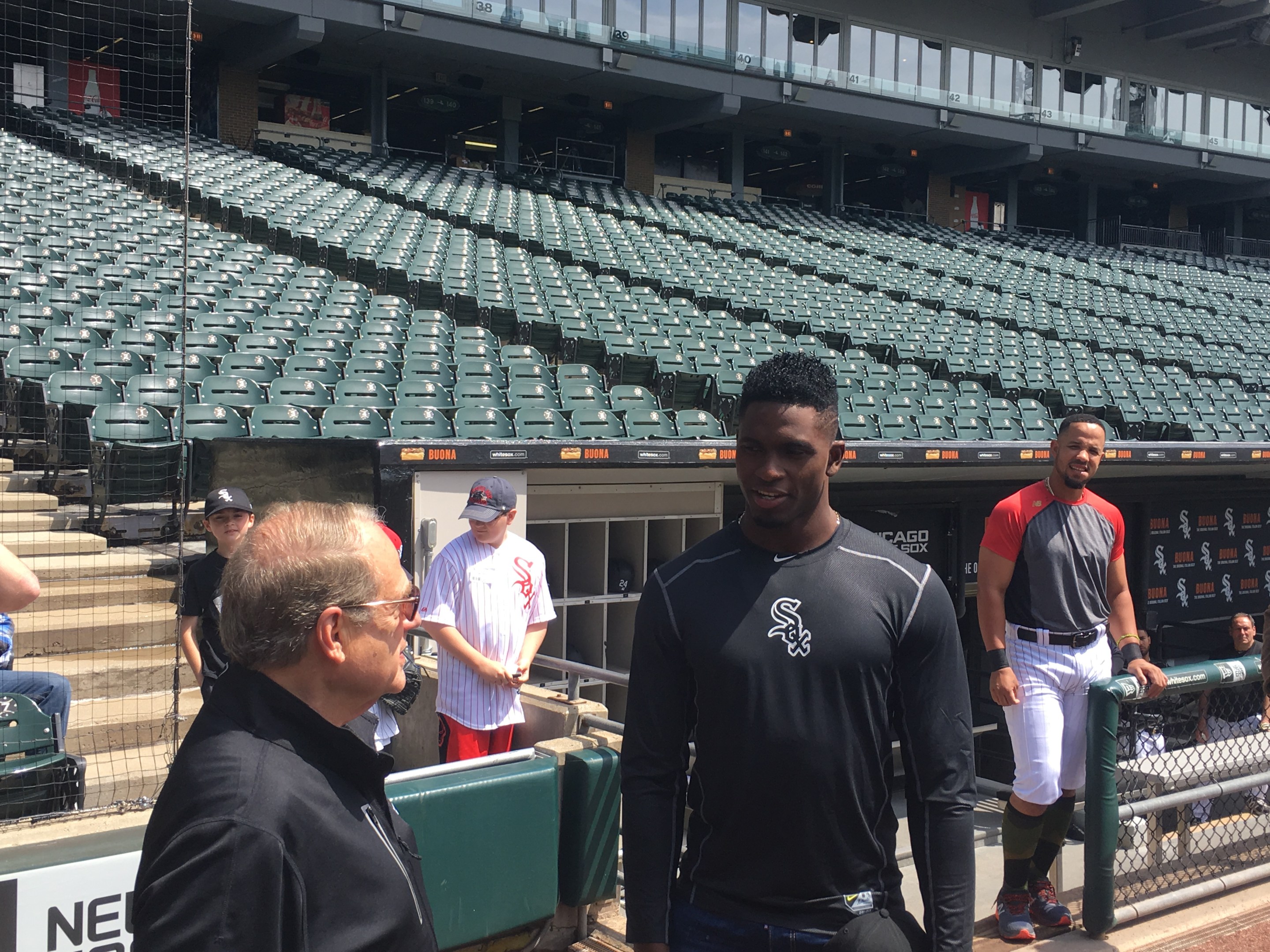
For someone present on the day the White Sox introduced Luis Robert Jr. back in 2017, with both Jerry Reinsdorf and José Abreu on hand to tour him around a field he wouldn't play on for another three years, a late-night January trade feels like an anticlimactic end for the highest-ceiling player of a crop that was supposed to bring multiple parades.
Robert's signing was a product of years of prior planning from Marco Paddy and the club's previous international scouting regime, and due to penalties on their IFA spending, required years of sacrifice afterward. In departing, he brings back Luisangel Acuña, an excitingly toolsy athlete who has nevertheless mostly been projected as a super-utility player up to this point, and right-hander Truman Pauley, a developmental arm who essentially received sixth-round money in last year's draft.
After signing a pre-debut contract extension that meant he entered the majors with $76 million guaranteed to his name, Robert departs the White Sox after accumulating exactly six years of service time. Though with the way general manager Chris Getz is talking, maybe being part of the trade that enabled the Sox to sign someone like Michael Conforto or Zack Littell could be added to Robert's underwhelming legacy in time.
"We've got some financial flexibility now to continue to bring in talent," Getz said, acknowledging that dumping Robert's $20 million salary on Steve Cohen opens up new budget room. "Look at our outfield and the defense with [Everson] Pereira and Acuña, those are really strong defenders. To be able to add to that group both offensively and someone that can play defense would be a way to improve the club, but different ways to get there, different ways to add value to your club. You don't just need to break down certain pockets of the team. It's really as a whole, a 26-man roster if not a 40-man. But we plan on being very active. We've already been talking to agents and clubs and anticipate a roster that's going to continue to evolve."
That introduction, to be honest, is a more cynical read. As much as three straight 100-loss seasons deservedly opens every White Sox move to cynicism, if Getz had to spend everyday saddled with trying to appropriately grapple with the false hope that was cultivated from 2017-2021, it would be hard to get out of bed, let alone find fair value.
Robert's centrality in the Sox universe and his trade value on the open market have been sharply diverging since the 2024 season began, and Getz portrayed trade negotiations where -- as hoped at the outset of the offseason -- a contending team grappling with a poor outfield market eventually found themselves at "a decision point." This return, however you feel about it, is one they had to wait on, though it's more than notable that Getz acknowledged considering many alternatives before deciding on a swap that involved the Mets taking on Robert's full salary.
"There were different concepts that were out there, but all things being equal, it really came down to the player return, do we like where this is at, and then there was a bonus of course with some financial flexibility." Getz said. "Yesterday morning is when [the Mets] felt like they were at a decision point. I don’t know what else they were working on. I’ve got a good relationship with [Mets GM] David Stearns. When you sense urgency and know something is real, you usually want to engage on it.
"Yesterday morning it picked up. Over the weekend, we had some discussions as well. I know they have been active in the free agent market and been able to convert on some moves. Perhaps they have missed on some players as well. You never know what’s going to affect the market. This weekend is when they connected with us and yesterday morning I felt like it was about to get pretty serious."
Acuña might very well be a pretty common name in Venezuela, but he is literally the younger brother of the former NL MVP and five-time All-Star Braves outfielder Ronald Jr. As such, genetics are strong enough of a thing where the 24-year-old multi-positional athlete offers 97th-percentile sprint speed and dizzying bat speed, especially for someone who only stands 5-foot-8, and the Sox have had interest in putting his raw ingredients into the hands of Ryan Fuller and their hitting development team for months now. If the White Sox are going to become any good, this is the sort of play they will need to run successfully, and run a lot. The Venezuelan Winter League is no grand proving ground, but Acuña is hitting .282/.397/.542 down there, already at work with swing changes geared at creating more loft.
"Last year with the Mets, my ground-ball rate was too high," Acuña said via interpreter. "That’s why I’ve been trying to stay behind the ball a little bit longer and trying to use more of my right leg in order to put the ball more in the air."
Acuña came up as an infielder and won't be throwing those gloves away, even if a first glance at the Sox depth chart suggests he could best get the runway to develop into an everyday player by staking claim to Robert's vacated spot in center. But since Acuña has spent the last two years accumulating below-average offensive numbers in both Triple-A and the majors, Sox officials aren't going out of their way -- at least not yet -- to sell him as a player who will provide tons of production on offense. Acuña's baserunning and defensive value are what made the trade fair, and unlocking his offensive potential is what could make it a win. After all, that's what the Mets could say about their side of the return, too.
Getz said that Pauley, a right-hander selected from Harvard last July, was the team's choice from a "pool" of options the Mets offered as a second piece. Ironically, Pauley spent much of his childhood receiving personal lessons from former White Sox pitching coach Ethan Katz. The raw potential of his hoppy fastball and sharp slider, and also his poor history of strike-throwing make Pauley pretty comparable to Mathias LaCombe's value at the tail-end of the White Sox prospect list (that's before mentioning they both parlayed 12th-round picks into bonuses of at least $400,000 despite unusual origins, with Harvard being only a slightly more likely source of talent than France). He's worth adding for a rebuilding club, and trading Robert barely a week before he was scheduled to appear at SoxFest will definitely reiterate a rebuilding feel to the event.
Taken another way, dealing Robert finally ends a drawn-out chapter keeping the White Sox from moving forward. Certainly the player, but also the team were stuck in this arrangement that both sides had long accepted had no real future, and it only became more awkward as the new core of Colson Montgomery, Kyle Teel, Shane Smith and others were existing side-by-side with the last vestige of the old one, even if it seemed as though they kind of liked one another.
Does trading Robert officially end the cycle of tearing down thinly-built would-be contending rosters, or simply reset it? Ideally, the new players and staff on hand get to determine that answer, even if Getz's first line of touting Acuña's merits began in a familiar way.
"We're talking about a player that's five-plus years of control."